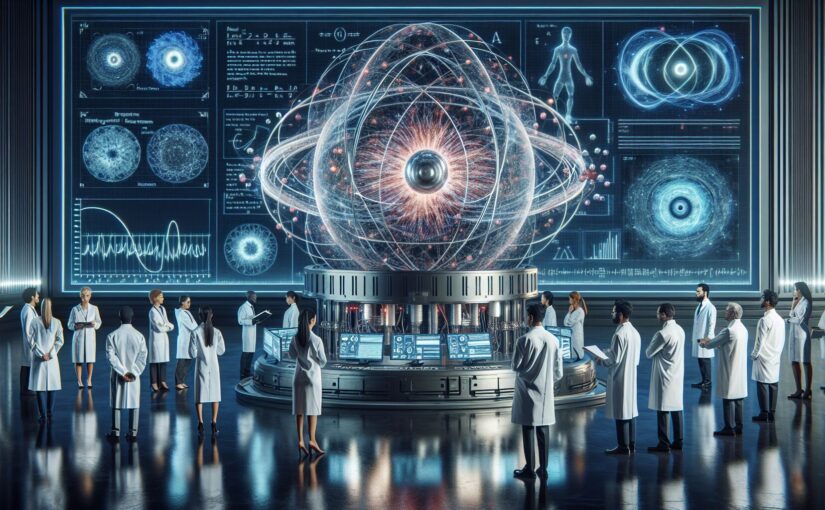
Hello, fellow tech enthusiasts and curious minds! Have you ever lay in bed at night, scrolling through the latest sci-fi movies and wondered, “Why don’t we have limitless energy by now?” I know I have. And while I don’t have a magic wand to grant us infinite energy just yet, today’s hot topic—or should I say superheated—is all about nuclear fusion. Let’s dive into the high-energy world of fusion, a promising frontier that might just revolutionize how we power our tomorrow.
What’s the Fuss About Nuclear Fusion?
Before we get too ahead of ourselves, let’s have a quick refresher on what nuclear fusion actually is. Imagine a dance party happening on the sun: hydrogen atoms are crashing into each other at breakneck speeds, fusing together, and releasing an absurd amount of energy in the process. Fusion is how the sun—and every other star, for that matter—produces energy. It’s like cosmic-level alchemy where hydrogen turns into helium, with a side bonus of pure energy.
What’s fascinating, and a bit intimidating, is that this has been happening for billions of years up in the sky. But here on Earth, taming such power has been a colossal challenge. Yet, we’re on the brink of making it work, and I don’t just mean in the wild imagination of a sci-fi book. Real-world scientists are pulling up their sleeves and putting some serious work into cracking this celestial code.
Why Nuclear Fusion Might Save the Planet
Here’s a fun nugget: fusion energy is as close to being “clean” as you can get. Unlike nuclear fission (which powers our existing nuclear reactors and our nightmares following every high-profile disaster), fusion doesn’t bring along the heavy luggage of radioactive waste. The byproduct of fusion? Helium, which is barely more dangerous than what you’d find in a party balloon.
Plus, the fuel for fusion reactions is abundant. We’re talking about hydrogen isotopes—think oceans of fuel, quite literally. Contrast this with our current exhausting hunt for oil and gas, and you’ll get why fusion sounds increasingly utopian.
More so, harnessing fusion energy means drastically reducing greenhouse gas emissions. With climate change bearing down on us like the world’s most persistent mosquito, fusion could be the bug spray we’ve all been desperately hoping for.
The Roadblocks: Fusion’s Challenges
While fusion sounds pretty nifty, the “hitch” is turning this dream into a repeatable, reliable technology. Researchers are trying to recreate the conditions of the sun—a venture not for the faint of heart. It means tackling immense pressures and temperatures hotter than the sun’s surface. Not exactly the kind of environment you’d want in your backyard barbecue, right?
Organizations like ITER (International Thermonuclear Experimental Reactor) and companies like Helion Energy are working to make this more than just a pipedream. However, it’s a slow burn. We still need huge breakthroughs in materials science, plasma physics, and energy management.
Even with these hurdles, progress is happening. Recent experiments have achieved power outputs higher than before, and with advances in supercomputing and AI, we’re solving fusion’s riddles faster than ever.
The Glimmer on the Horizon: The Future of Fusion
Let me play the prediction game for a moment. Imagine a world 20 to 30 years from now. Nuclear fusion isn’t just a feature story on the latest issue of “Futuristic Innovations Monthly” (does that exist? It should). Instead, it’s how we power our homes, our cars, and even those cool interstellar spaceships they’re always bragging about in the movies.
A world where energy scarcity is replaced by abundance, where the air is cleaner, and where energy disputes are relics of the past. It’s a vision not just of sustainability, but of true energy freedom.
Will we get there? I’m a believer. But until then, researchers will be donning lab coats and referencing science as I reference Netflix—for hours on end. The results could transform existing utilities, usher in a new age of renewables, and dare I say, put Big Oil out of business. A dream, sure, but one we’re inching closer to every day.
Final Thoughts
Fusion, though still in its early years as a real energy source, could be a massive breakthrough just around the corner. Speaking as a hopeless optimist in the world of tech, seeing this unfold is like watching a carefully crafted jigsaw puzzle come together. Granted, we’re not quite ready to kick back and bask in fusion achievements, but the pieces are swiftly locking into place.
So, next time you find yourself sprawled on your couch, musing over the energy crises of today, remember there’s a whole community of super-smart folks working to make our future bright—literally. As for me, I’ll be keeping a hopeful eye on these developments, like a kid waiting for the latest video game console but with much more potentially world-saving implications.
Until next time, stay curious, stay hopeful, and keep the dream of a fusion-powered utopia alive. Catch you on the flip side of that exponential energy curve!