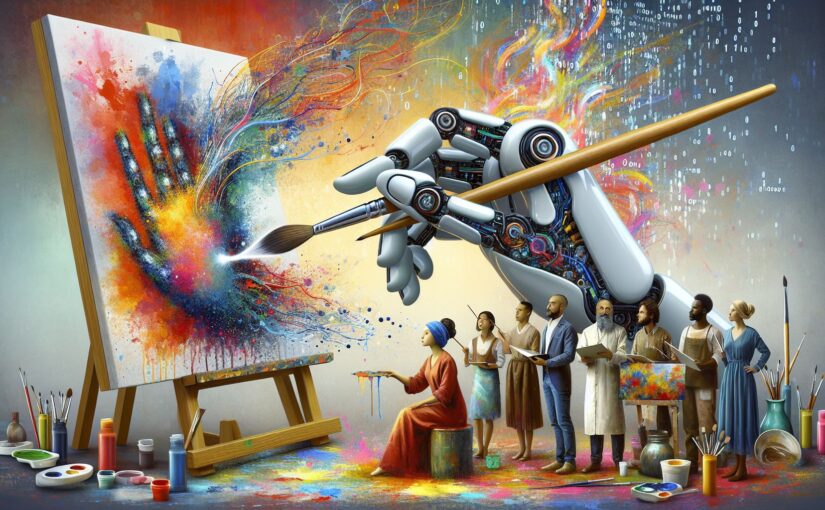
Hey fellow tech enthusiasts! Today, let’s talk about AI in creative arts, a topic that’s been generating a whirlwind of buzz lately, and for good reason. Imagine a future where our wildest imaginations are brought to life by artificial intelligence! Before you dismiss it as the tech fantasy of the year, stick around. It’s real, it’s happening, and it’s as cool as it sounds.
Once Upon a Time in AI Land
Let’s reel back to a time before the polymers hit the fan. AI was once that quirky, nerd-cave curiosity. The “R2-D2 of potential” making cameo appearances in overactive imaginations across Silicon Valley. Fast forward to today, and AI has become an all-your-bases-are-belong-to-us powerhouse, rapidly redefining the rules of creativity.
Think of AI tools like GPT-4 conjuring up poetry that ushers Shakespeare into 2023, or DALL-E painting dreamscapes that stretch beyond Van Gogh’s fever dreams. Back in the 90s, who’d have thought technology would lend its circuits to the arts like this? Instead of just crunching numbers and sifting through spreadsheets, AI is out there helping creatives break boundaries.
Digital Paint and Poetry
Over the past year or so, AI art generators have stolen the spotlight. Let’s face it, we humans are a little crazy about art. Art transcends cultures, economies, and time. It’s the space where we spill our most raw emotions in bright neon or brooding sepia. AI is turning that world on its head.
Today, artists from all over the globe, backyard canvasser or gallery titan alike, use AI not just as a tool, but as a collaborative partner. Platforms like OpenAI’s DALL-E or DeepArt let artists work with algorithms to create pieces that defy conventional limits, mixing abstract dreams with brushstrokes of logic. Art is no longer chained by human hands alone.
And it’s not just visuals! AI drifts gracefully into poetry and prose. GPT-4 and its successors have mused, meandered, and manifested pieces that make you ponder whether silicon can have soul. There’s something deeply weird when a non-sentient machine pens tales that brim with existential angst or joy.
Jamming with the Machines
Now, about music. If you thought AI would stop at Impressionism, think again. Imagine a Daft Punk karaoke night with Beethoven and Jimi Hendrix on the same roster, all orchestrated by AI. Platforms like AIVA (Artificial Intelligence Virtual Artist) and Amper Music create symphonies from mere suggestions, charting new musical territories.
Spotify’s personalized playlists already use machine learning to anticipate our deepest music desires. But it’s the creation process that’s changing dramatically. Musicians are co-creating with AI, bringing a different depth to their compositions and adding flavors that span the realms of sound from techno to classical.
The Line Between Creator and Creation
With all this innovation comes a hefty dose of philosophical pondering. Just what is creativity? If machines can help to dream and craft art, where do we draw the line between creator and creation? I once read a hilarious tweet from a disgruntled artist suggesting that in worst scenarios, artists now need therapy to deal with AI outperforming their muses. Kidding aside, these questions need answers.
Challenges on the Horizon
As with anything new and disruptive, it’s not all rainbows and unicorns. AI in creativity faces its own set of challenges. Intellectual property rights spring up like mushrooms in the night. The debate around “who owns the art” is alive and well, raising eyebrows among artists and entrepreneurs alike.
Moreover, the area where AI still lags is heart. Art isn’t only about precision or the gloss of perfection. It’s about the raw imperfections that sing to our souls. Can a machine that doesn’t feel ever truly create art that brings tears? That mystery keeps the heart-hat debate very much alive.
Social and ethical considerations also play out in a broader arena. AI revealing biases inherited from dated datasets can inject unintentional prejudices into creative outcomes. But fear not, artists! The latest efforts by many organizations aim to combat these biases. Phew!
Looking into the Future
What lies ahead for AI in the creative arts is anyone’s guess, and it’s the speculation that makes our inner techie pulse with excitement. Already, we’re seeing unique AI-human collaborations popping up, pushing the boundary of creative exploration. Will AI become the darling of jazz improvisation? Or perhaps it’ll usher in a golden era of digital filmography through dynamic plot creation? The joy of the unknown is half the thrill.
In an optimist’s view, the fusion of AI and human creativity could lead to an era where innovation towers over not just our boxes of wires but our museums of thought. New mediums ripe for discovery, old genres revitalized, and horizons broadened, offering a renaissance fueled by artificial inspiration.
Final Thoughts
So here we are, standing at the edge of the known creative world, with AI chaperoning us to what we once thought was only possible in Sci-Fi movies. Whether you’re an artist craving collaborative creations, or just a tech junkie craving what’s next, there’s no denying that the AI art revolution has started something big.
And the best part? We’re only in the early chapters. There’s an entire story left to unfold, a canvas of endless possibilities just waiting for that first brushstroke.
Until next time, keep being curious, keep questioning, and, most importantly, keep creating, whether it’s you or your trusty AI counterpart holding the brush. Spoiler alert: creativity is collaboration in this brave new world!