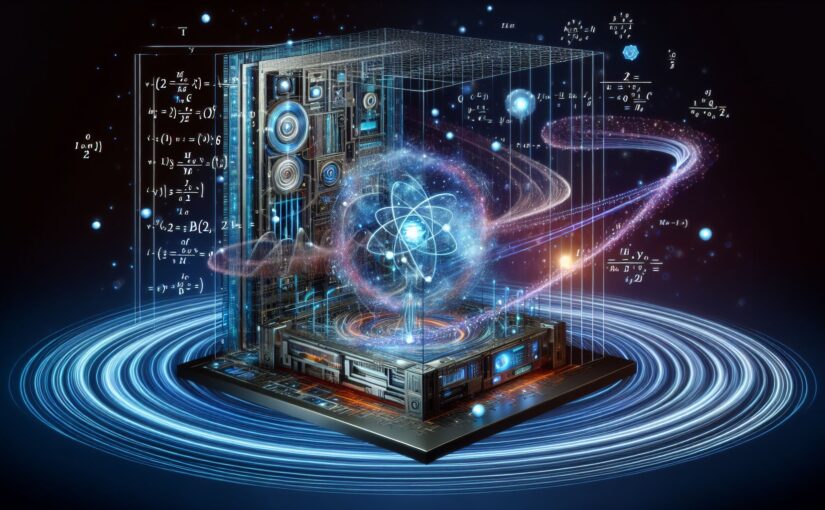
Introduction: The Quantum Leap
Have you ever felt like we’re on the brink of something huge? That electric buzz in the air, a little bit like standing at the edge of the Grand Canyon or witnessing a breaking dawn? That’s how I feel about quantum computing right now. If you’re not familiar with it yet, don’t worry. Quantum computing isn’t just about super-fast calculations. It’s about fundamentally changing how we understand and interact with the universe. I know, I know—it sounds like science fiction, but bear with me. We’re diving into the realm where physics and computers collide, and the results are pretty wild. Grab your flux capacitor, and let’s explore this techno-utopian dream!
Quantum What? Understanding the Basics
Before we launch into full nerd mode, let’s break down the basics. Traditional computers use bits—ones and zeros, a binary language, like a light switch that’s either on or off. But quantum computers? They’re the trendy tech wizards that use qubits. So, what’s the big deal with qubits, you ask? Well, they can be both on and off simultaneously, thanks to a mind-bending principle of quantum mechanics called superposition. Picture a cat that’s both asleep and chasing a laser pointer at the same time—that’s your qubit.
Then there’s this wild phenomenon called entanglement. When qubits become entangled, the state of one qubit can instantly affect the state of another, no matter the distance between them. Cue spooky ’70s disco music—it really is a dance of the cosmos.
Tech Titans Lead the Charge
Some folks in Silicon Valley and beyond are furiously working to make quantum computing a practical reality. Companies like IBM, Google, and Microsoft are at the forefront, developing quantum processors alongside startups like Rigetti and D-Wave. Remember when IBM’s Deep Blue beat Kasparov in chess? Consider these quantum magicians today’s iteration, nudging the throne of conventional computing.
In late 2019, Google claimed “quantum supremacy” with their Sycamore processor by solving a problem in seconds that would’ve taken a supercomputer an eternity (okay, like 10,000 years, but who’s counting?). Of course, the tech community loves a good debate, and this claim sparked some heated discussions. Fasten your seatbelts. It’s going to be a bumpy ride as tech giants vie for dominance.
Potential and Promise: The Good Stuff
So, what kinds of doors does quantum computing open? Frankly, it feels like asking what kind of doors winning the lottery opens. The possibilities are, well, let’s say they’re beyond traditional computing.
Secure Communications
Imagine unhackable communications. Quantum entanglement could create encryption that’s basically invulnerable to eavesdroppers. It’s like James Bond levels of encryption, bring on the invisible cars and gadgets, shaken, not stirred.
Drug and Material Discovery
In healthcare and materials, quantum computers could simulate molecular interactions at speeds incomprehensible to classical methods. This could unlock breakthroughs in drug discoveries, new materials, and green technologies. Think of it as playing SimCity, but you’re crafting actual molecules, like chemical architects in a future metropolis.
AI and Beyond
Artificial Intelligence is already rocking our world, but quantum computing could catapult it into a dimension where AI models learn and evolve beyond our current understanding. We’re talking about machines that might one day truly “understand” context, emotion, and the complexities of human language.
Tackling Climate Change
And let’s not gloss over the environmental implications. Quantum computing could optimize large-scale climate models and sustainable practices much faster than today’s supercomputers, arming us with powerful new tools in the fight against climate collapse.
The Quantum Conundrum: Challenges and Critiques
Alright, enough hype for a moment. Let’s talk a bit about the hurdles. Building a quantum computer isn’t just about fancy algorithms and genius code. It’s a delicate dance with nature herself.
Error Rates and Stability
Quantum computers are notoriously finicky. Those qubits? They’re prone to errors due to environmental noise. Imagine trying to conduct an orchestra in a windstorm. That’s a day in the life of a quantum engineer. Reducing these error rates and achieving stable, scalable systems is a colossal challenge.
The Temperature Trap
Let’s not forget the optimal temperature for many quantum systems is a few millikelvin—around a hundredth of a degree above absolute zero. In other words, colder than outer space. Creating and maintaining these conditions are both costly and complicated.
Societal Implications
We also have to ponder the societal impact. What happens if quantum computers fall into the wrong hands? Unbreakable codes are fantastic unless you’re trying to catch a criminal. There’s a significant ethical and geopolitical dimension here that needs careful navigation.
Looking Ahead: The Quantum Future
We’re standing on the cusp of a quantum renaissance. Though commercial quantum computers aren’t quite ready for prime time from your neighborhood electronics store, the day’s not too far off. When that happens? Who knows, I’m predicting a whole new era of innovation across industries. Now that’s a future worth geeking out over.
As we unravel this mystery of the universe, it feels a bit like joining a secret society where the membership card reads “quantum zealot” instead of “run-of-the-mill techie.” So the next time you’re chatting with your algorithmically-inclined buddy or across the Reddit boards, throw in some qubits and watch eyes widen and conversations leap into new dimensions.
For now, let’s savor this moment of technological intrigue and the promise that the quantum world is soon to be our own playground. Because if quantum computing doesn’t leave you awestruck, I’m not sure what will. Here’s to a future that’s hyperbolic, maybe, but justifiably so. Let’s unlock the universe, sprinkle a dose of magic math, and likely, just possibly, change everything.